


Stingray Kids' Short Sleeve UV Rash Shirt UPF 50+
Stingray Kids' Short Sleeve UV Rash Shirt UPF 50+
 Blocks 98% of Harmful UV Rays
Couldn't load pickup availability
 Dermatologist Recommended
Dr Dev Shah · Consultant Dermatologist & Mohs Surgeon
Dermatologist Recommended
Dr Dev Shah · Consultant Dermatologist & Mohs Surgeon
Delivery information
UK shipping
- Royal Mail 24 (2–3 working days)£5.99
- Royal Mail 48 (3–4 working days)£4.99
International shipping
Calculated at checkout. Free on orders over £200.
Complete their sun protection with


Description
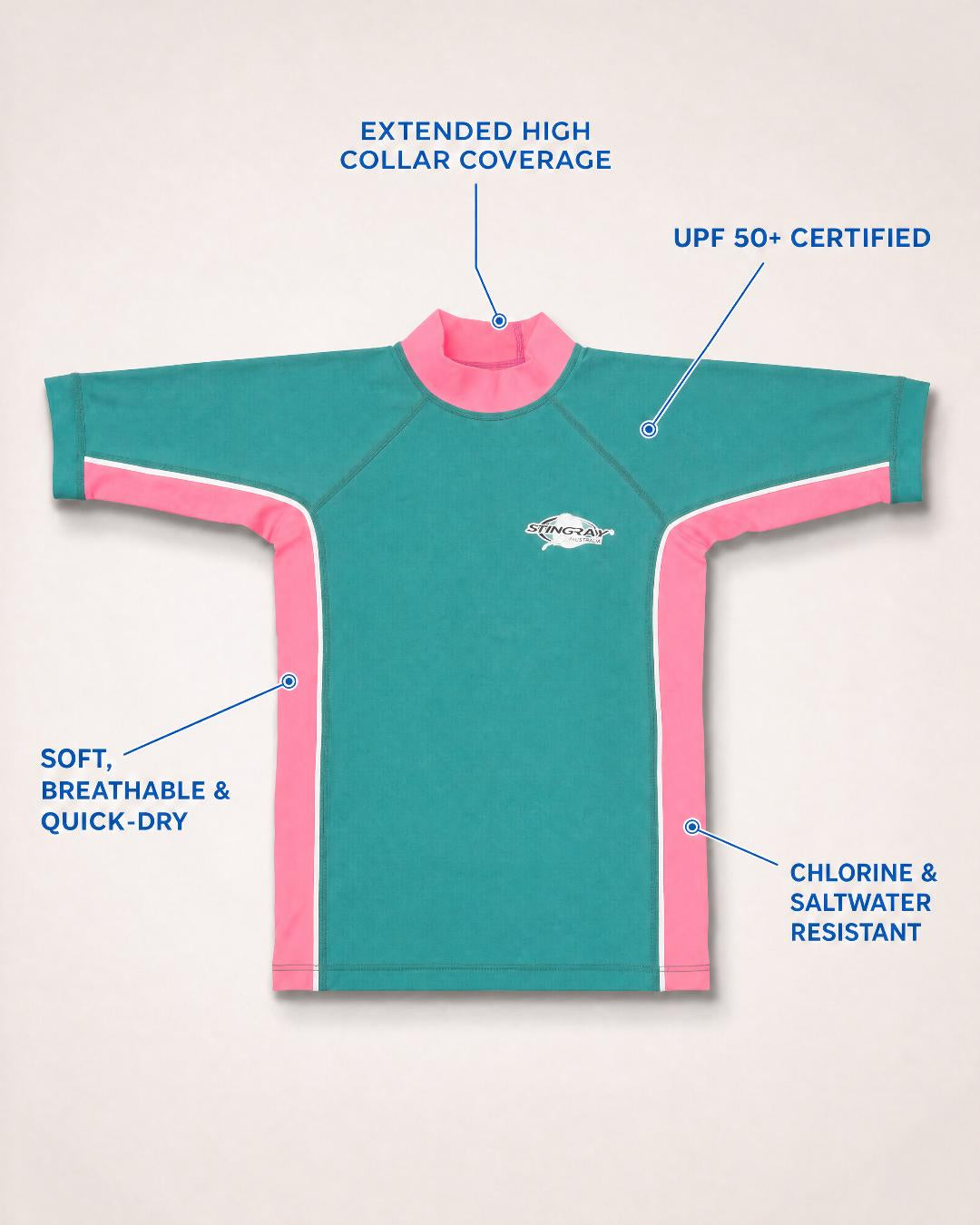
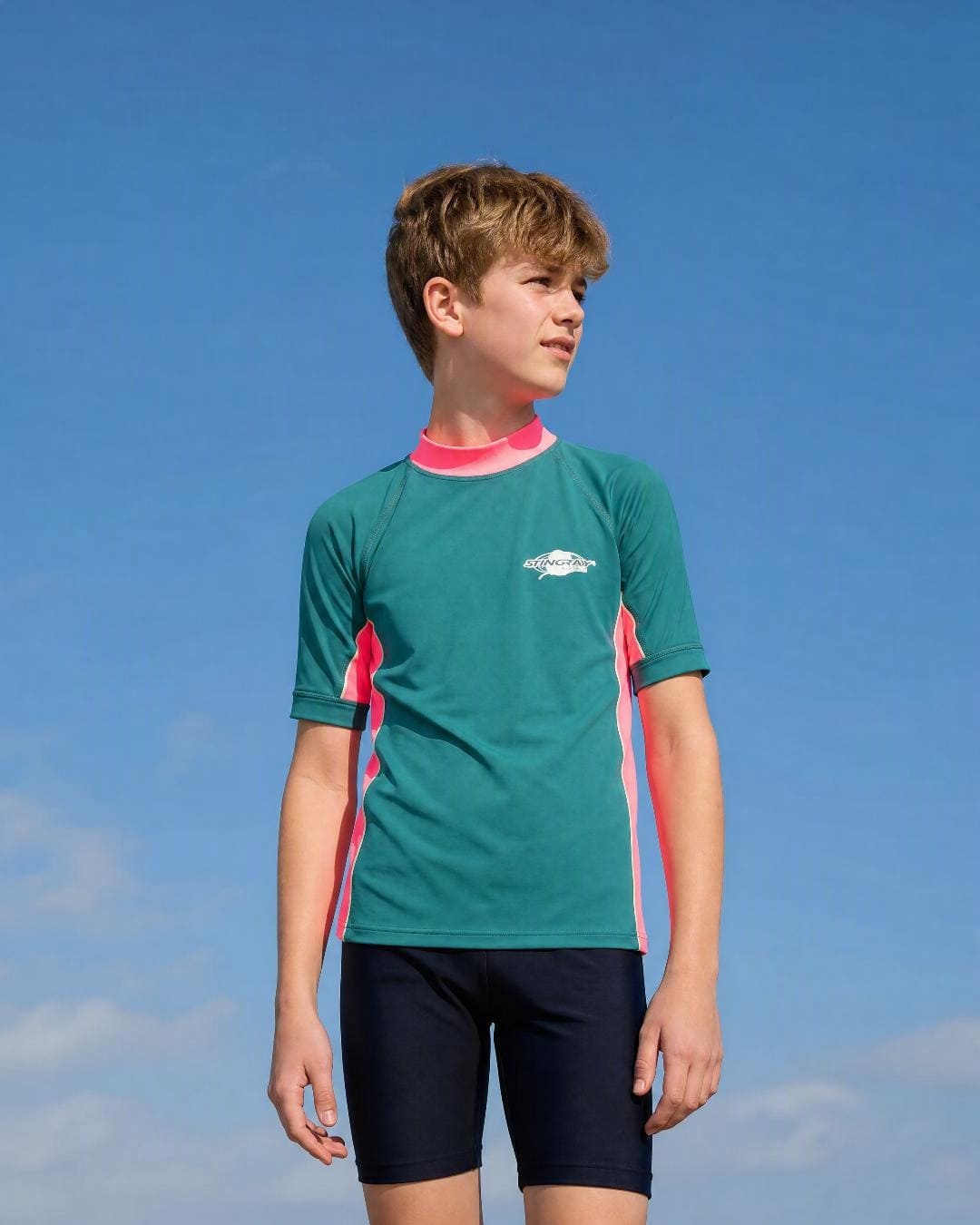
A kids' short sleeve rash vest with a high collar that covers the neck, where kids often burn. The certified UPF 50+ fabric blocks 98% of UVA and UVB rays, and because the protection is woven into the fibre and the weave rather than applied as chemicals, it cannot wash out or wear off.
The fabric is a lightweight, quick-dry stretch blend that feels like activewear, so it works as well for running around the beach as swimming in it, and it resists chlorine and saltwater. Pair it with UV swim shorts or leggings for the bottom half. Sizes 4 to 14 years, in sixteen colourways for boys and girls.
Features
- Certified UPF 50+, independently tested to AS/NZS 4399
- Blocks at least 98% of UVA and UVB rays
- Extended high collar covering the neck
- 4-way stretch, comfortable close fit
- Chlorine and saltwater resistant
- Fast drying, lightweight and breathable
- Flat seams to prevent chafing
- Six sizes for ages 4–14 years, in 16 colours
Fabric & care
Fabric: Polyester & PBT blend.
- Machine wash cold, maximum 30 degrees, with a mild detergent
- No bleach or fabric softener
- Rinse in clean water after swimming to remove salt and chlorine
- Air dry flat or hang in the shade
- Keep away from rough surfaces to prevent snags
- Store in a cool, dry place


Kids' Stingray Sizing Table
SIZE GUIDE
Find your size
Height is the best guide for children. Use weight to confirm.
- Up to 6 months Height61 – 71 cm24" – 28" Chest—— Waist—— WeightUp to 8 kgUp to 17.5 lb
- Up to 18 months Height71 – 81 cm28" – 32" Chest—— Waist—— WeightUp to 10 kgUp to 22 lb
- Age 2 Height91 – 102 cm36" – 40" Chest56 – 58 cm22" – 23" Waist46 – 48 cm18" – 19" Weight12 – 14 kg26 – 31 lb
- Age 4 Height102 – 112 cm40" – 44" Chest61 – 64 cm24" – 25" Waist48 – 51 cm19" – 20" Weight15 – 19 kg33 – 42 lb
- Age 6 Height112 – 122 cm44" – 48" Chest66 – 69 cm26" – 27" Waist51 – 53 cm20" – 21" Weight19 – 24 kg42 – 53 lb
- Age 8 Height122 – 132 cm48" – 52" Chest71 – 74 cm28" – 29" Waist53 – 56 cm21" – 22" Weight25 – 30 kg55 – 66 lb
- Age 10 Height137 – 145 cm54" – 57" Chest74 – 76 cm29" – 30" Waist56 – 58 cm22" – 23" Weight31 – 37 kg68 – 82 lb
- Age 12 Height147 – 155 cm58" – 61" Chest79 – 81 cm31" – 32" Waist58 – 62 cm23" – 24.5" Weight38 – 42 kg84 – 93 lb
- Age 14 Height157 – 165 cm62" – 65" Chest84 – 86 cm33" – 34" Waist62 – 65 cm24.5" – 25.5" Weight42 – 47 kg93 – 104 lb
Between sizes? Take the larger. Children grow through a size in a season, and a little room does not affect sun coverage. The two youngest sizes are chosen by height and weight only.
How to measure
- Height.
- Chest. Around the fullest part of the chest, arms relaxed at their sides.
- Waist. Around the narrowest part of the middle, just above the belly button.
- Keep the tape level all the way round, snug but not tight.
Ages are a guide only. Always choose by height and weight where you can.

Maximum Protection

Salt & Chlorine Resistant

Quick-Drying

Breathable
Less than 1 in 50 UV rays reach the skin
That is what UPF 50+ means, tested and certified to the Australian standard AS/NZS 4399:2020. An ordinary t-shirt worn in the water can let far more UV through, especially wet; nothing on its label tells you how much. Here the protection is woven in, from the fibres and the density of the weave rather than a chemical finish, so there is nothing to wash out and nothing to reapply.
A collar that covers the neck
Most kids' swim tops finish at the collarbone and leave the neck in full sun. This UV rash vest has an extended high collar, so the neck is covered by certified fabric rather than relying on suncream that rubs off in the water.

One top for the whole beach day
Light, breathable stretch fabric that feels like a sports top, so it goes from swimming to sandcastles to lunch without a change of clothes.
It resists chlorine and saltwater, keeps its full UPF 50+ rating when wet and is dry again shortly after they towel off, ready for the next swim.

Fabric, fit and coverage
Made by Stingray, weaving certified UPF fabric in Australia since 1986.
- FabricCertified UPF 50+ lightweight stretch blend
- Tested toAustralian standard AS/NZS 4399:2020
- UPF when wetStill 50+, in and out of water
- CoverageTorso, shoulders, upper arms, neck
- StyleShort sleeve swim shirt, extended high collar
- In waterChlorine and saltwater resistant, quick dry
- Sizes4–14 years
- ColoursSixteen colourways

Six sizes, ages 4 to 14
Height is the best guide, with weight to confirm. Between sizes, take the larger: children grow through a size in a season, and a little room does not affect sun coverage.
Height is the best guide. Between sizes, take the larger; a little room does not affect sun coverage.
- Age 4102 – 112 cm tall
- Age 6112 – 122 cm tall
- Age 8122 – 132 cm tall
- Age 10137 – 145 cm tall
- Age 12147 – 155 cm tall
- Age 14157 – 165 cm tall
What parents ask us
What do they wear with it?
Their usual swim bottoms: trunks, a swimsuit bottom, or UV swim shorts or leggings if you want the legs covered too. The rash vest is worn on its own like a top, with nothing needed underneath.
Can they swim in it?
Yes, it is made for the water. The fabric resists chlorine and saltwater, keeps its full UPF 50+ rating when wet, and dries quickly.
Why not just wear a t-shirt in the water?
An ordinary cotton t-shirt gives far less UV protection than a certified UPF 50+ top, and less again when wet. It also goes heavy and cold, dries slowly and drags in the water. A rash vest, also called a rash guard or swim shirt, is cut for swimming and keeps its rating wet or dry.
Does my child still need suncream?
Yes, on the skin the top does not cover: face, ears, forearms, hands and legs. Reapply after swimming. A UPF 50+ sun hat covers the head and ears, and UV swim shorts or leggings cover the bottom half.
Which size should I choose?
Go by height first and use weight to confirm; ages are a guide only. Between sizes, take the larger. Children grow through a size in a season and a little room does not affect sun coverage.
Will the UV protection wash out?
No. It comes from the fibres and the density of the weave, not a chemical coating, so there is nothing to wash out or wear off. Rinse in fresh water after swimming, wash cold at a maximum of 30 degrees, and air dry.
Is it suitable for eczema, sensitive skin or a child who cannot be in the sun?
Yes. The fabric is smooth, seam-light and carries no chemical UV finish, which is why it suits eczema and sensitive skin. Parents also buy it for children with photosensitivity conditions such as vitiligo and actinic keratosis, autoimmune conditions such as lupus, scleroderma and dermatomyositis, genetic conditions such as EPP, ichthyoses and Bloom syndrome, and children going through chemotherapy, radiotherapy or immunosuppressive treatment. We cannot give medical advice, so follow your child's consultant on how much cover they need.
“equatorsun began after my mum, Annette, was diagnosed with melanoma in 2006. We lost her in 2009, and the family has carried on her mission since.”George, equatorsun
